Probiotic compliant with EFSA and EU law – How to Check Ingredients, Labelling and Strain Origin
Which regulations govern the sale of supplements containing live bacterial cultures? What role does the European Food Safety Authority (EFSA) play, and where can consumers find documentation concerning the Narine strain?
How Does the European Union Regulate Probiotic Supplements?
Food supplements are classified as food products in the European Union. This means they are subject to food legislation rather than the marketing authorisation procedures applicable to medicinal products.
The main requirements are established by several legal acts.
Directive 2002/46/EC establishes rules for food supplements, including basic requirements concerning their presentation and labelling.
Regulation (EU) No 1169/2011 governs the provision of food information to consumers, including ingredient lists, allergen information, and details identifying the responsible food business operator.
Regulation (EC) No 1924/2006 establishes the rules for using nutrition and health claims.
In Poland, additional provisions include the Act of 25 August 2006 on Food and Nutrition Safety and the Regulation of the Minister of Health of 9 October 2007 concerning the composition and labelling of food supplements.
These regulations also apply to products containing lactic acid bacteria, including Narine supplements.
What Is EFSA’s Role in Evaluating Probiotics?
EFSA, the European Food Safety Authority, is responsible for scientific assessments concerning food safety and health claims.
The Authority examines scientific documentation and prepares opinions that may be used when regulatory decisions are made at the European Union level.
In the case of health claims, EFSA assesses whether the scientific evidence supports the proposed relationship between a food ingredient and a specific health effect.
Does EFSA Approve Probiotics?
EFSA does not operate a system for approving individual probiotic supplements for sale.
It also does not issue certificates automatically confirming the effectiveness of specific products available on the market.
Three separate aspects should be distinguished:
- Product safety – the food business operator is responsible for ensuring that the supplement complies with applicable food legislation.
- Scientific research on a strain – provides information about the properties of a particular microorganism.
- Health claims – are subject to separate scientific assessment and authorisation procedures within the European Union.
A product may contain a bacterial strain described in scientific publications even if no separately authorised health claim exists for that strain.
What Are Health Claims and Who Authorises Them?
A health claim is any statement that states, suggests, or implies a relationship between a food, one of its ingredients, and human health.
The rules governing such statements are established by Regulation (EC) No 1924/2006.
Manufacturers cannot freely attribute health benefits to food supplements. Commercial communications must comply with the relevant legal requirements and conditions for using health claims.
Who Decides Whether a Health Claim Is Authorised?
EFSA conducts the scientific assessment, while authorisation decisions are made at the European Union level through the relevant procedures involving the European Commission.
The European Commission also maintains a public register containing authorised and non-authorised health claims, together with the relevant conditions of use.
The register is available here:
EU Register of Nutrition and Health Claims.
Are There Authorised Health Claims for Lactic Acid Bacteria?
Yes, but they concern specific bacterial cultures and products rather than all lactic acid bacteria.
One example is the authorised claim that live cultures in yoghurt improve lactose digestion in individuals who have difficulty digesting lactose.
This claim concerns the specific cultures Lactobacillus delbrueckii subsp. bulgaricus and Streptococcus thermophilus, provided that the established conditions are met.
The claim cannot automatically be extended to all bacteria used in milk fermentation or to supplements containing the Narine Er 317/402 strain.
Narine Er 317/402 – Why Is Precise Strain Identification Important?
In microbiology, the bacterial species name alone is not always sufficient to identify a microorganism precisely.
Individual strains belonging to the same species may differ in their biological properties, metabolism, and behaviour under particular conditions.
For this reason, identifying the exact strain is particularly important for products containing live bacterial cultures.
Narex supplements contain the strain traditionally designated as:
Lactobacillus acidophilus n.v. Er 317/402 Narine.
What Does Er 317/402 Mean?
Er 317/402 is the individual strain designation of Narine.
It distinguishes Narine from other bacteria described as Lactobacillus acidophilus and connects it to its history and microbiological documentation.
The Narine strain was developed in Armenia through research conducted by Professor Levon Akopovich Erzinkyan and his team.
In 1964, research concerning Narine was formally registered, and the bacteria subsequently began to be used in the production of fermented dairy products.
In 1999, the Armenian manufacturer Narex entered into an agreement with the National Academy of Sciences of Armenia concerning the right to use the reference Narine bacterial culture.
This is one of the elements documenting the origin of the strain used in Narex products.
More information is available on the Narex website.
How Can You Check Scientific Research on the Narine Strain?
The first step in reviewing information about a bacterial strain is identifying its full scientific designation.
You can then search for relevant publications in scientific databases such as PubMed.
For Narine, useful search terms include:
- Lactobacillus acidophilus Er 317/402 Narine;
- Lactobacillus acidophilus INMIA 9602 Er-2 strain 317/402;
- Narine Er 317/402.
What Research Has Been Conducted on Narine?
Scientific literature includes publications examining the fermentation properties, antimicrobial activity, and interactions of the Narine strain with intestinal microorganisms.
A study published in 2017 in Letters in Applied Microbiology investigated the effects of a preparation containing Narine on selected growth parameters of Escherichia coli bacteria present in the gut microbiota of individuals with familial Mediterranean fever.
Subsequent publications, including studies from 2018 and 2021, examined changes involving specific groups of intestinal microorganisms following the administration of Narine-containing preparations.
These studies provide information about the properties and interactions of the strain under defined research conditions.
However, they do not constitute authorisation of a health claim or confirmation of therapeutic effects for every product containing Narine.
Search PubMed for Narine Er 317/402 Research.
How to Read a Narine Supplement Label
A food supplement label is one of the primary sources of information about the product.
Under food legislation, it must provide specified information allowing consumers to understand the supplement’s composition and directions for use.
1. Full Bacterial Strain Name
Narex products identify the strain as Lactobacillus acidophilus n.v. Er 317/402 Narine.
The full designation allows the microorganism to be identified and connected to its scientific documentation.
2. Bacterial Count Expressed in CFU
CFU stands for Colony Forming Units.
This measurement is used to determine the number of viable microorganisms capable of forming colonies under appropriate laboratory conditions.
The CFU counts in Narex supplements vary depending on the product:
| Product | Bacterial count per capsule or sachet |
|---|---|
| Narex Caps | 1.8 × 10⁸ CFU |
| Narex Sachets | 3 × 10⁸ CFU |
| Narex Forte | 2.7 × 10⁸ CFU |
| Narex Duo | 1.8 × 10⁸ CFU |
All variants contain the same Narine Er 317/402 strain. Narex Duo additionally contains inulin.
It is useful to check what quantity of the product the declared CFU count refers to and whether the manufacturer provides information about bacterial viability throughout the product’s shelf life.
A CFU value on a supplement label should not automatically be assumed to refer only to the date of manufacture.
3. Recommended Daily Serving
Food supplement packaging must state the recommended daily serving.
It must also include a warning not to exceed that amount.
Supplements should be used according to the instructions for the specific product.
4. Storage Conditions
Storage conditions are particularly important for preparations containing live microorganisms.
Temperature, humidity, and transportation conditions can influence the stability of bacterial cultures.
Narex products containing freeze-dried Narine bacteria should be stored at temperatures up to +8°C, according to the manufacturer’s recommendations.
5. Ingredient List and Allergen Information
Consumers should check the full ingredient list, including additional substances and allergens that must be declared under applicable legislation.
The composition of Narex supplements varies by product.
For example, Narex Duo combines the Narine strain with inulin, while Narex Sachets contain a freeze-dried Narine culture in powder form.
6. Details of the Responsible Food Business Operator
Food labelling must allow consumers to identify the food business operator responsible for the product information.
It is also useful to check the country of origin when this information is provided or legally required, along with details allowing the product batch to be identified.
Narex products are manufactured by the Armenian company Narex, while ProBiomarket Sp. z o.o. is responsible for their import and distribution in Poland.
Do Narine Supplements Have to Be Notified to GIS in Poland?
In Poland, placing a food supplement on the market for the first time is subject to a notification obligation under the relevant provisions of food legislation.
This requirement follows from Article 29 of the Polish Act on Food and Nutrition Safety.
The notification is submitted electronically by the responsible food business operator.
What Is Food Supplement Notification?
Notification involves providing the competent authority with the required information about a product.
This includes details such as its name, form, composition, and labelling.
The Chief Sanitary Inspectorate (GIS) maintains a public register of products covered by first-market-placement notifications.
Information about the notification process and access to the register is available on the Chief Sanitary Inspectorate website.
Does Inclusion in the GIS Register Mean That a Supplement Is Approved?
No. GIS notification is neither a marketing authorisation nor a certificate of a supplement’s effectiveness.
The food business operator remains responsible for ensuring compliance with requirements concerning food safety, composition, labelling, and advertising.
GIS may conduct explanatory proceedings, while the competent authorities of the State Sanitary Inspection supervise products available on the market.
Notification should therefore not be confused with approval by EFSA or GIS.
How Can You Check Whether Information About Narine Complies With EU Regulations?
Reviewing information about a supplement can be divided into four main steps.
Step 1. Identify the Strain
Check whether the manufacturer provides the microorganism’s full designation.
For Narine, this is Lactobacillus acidophilus n.v. Er 317/402 Narine.
Precise identification helps distinguish research concerning this strain from studies involving other bacteria belonging to the same species.
Step 2. Review the Product Label
Check the composition, CFU count, recommended daily serving, best-before date, and storage conditions.
Also review the details of the responsible food business operator and any declared allergens.
Step 3. Check Health Claims
If the packaging or website contains a statement about a specific health benefit, you can check its regulatory basis under EU health claims legislation.
The official register maintained by the European Commission is a useful reference.
It is important to consider the exact wording of the claim, the conditions for its use, and any relevant transitional provisions.
Step 4. Verify the Origin and Documentation
Review information about the manufacturer and the origin of the bacterial strain.
For Narine, important elements include its Armenian history, the Er 317/402 designation, and documentation connecting it to the original bacterial culture.
Information about the strain is available on the Narex website.
Why Does the Origin of the Narine Strain Matter?
When choosing a supplement containing live bacterial cultures, it is useful to know exactly which microorganism is used in its production.
The history of Narine is connected to research conducted in Armenia since the mid-20th century.
The Er 317/402 strain was used in fermented dairy products and later in preparations containing freeze-dried bacterial cultures.
Narex has been developing Narine-based products since 1999, using a reference culture associated with the National Academy of Sciences of Armenia.
Documentation of the strain’s origin makes it possible to connect the microorganism used in production with the historical source of the bacterial culture.
This is particularly important for products marketed under the Narine name, because a commercial name alone does not replace precise microbiological identification.
Narine in Narex Products – Strain Identification and Composition
Narex supplements available in Poland contain the same Narine Er 317/402 strain.
Individual products differ in their form, bacterial count, and additional ingredients.
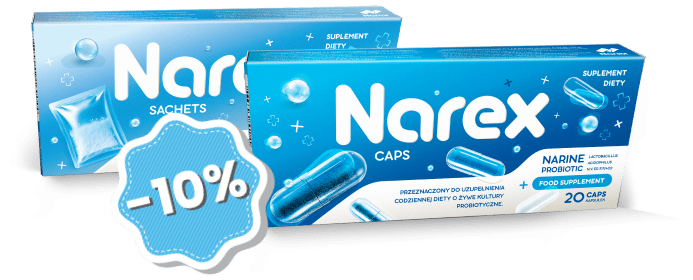
Narex Caps is the standard capsule formulation. Narex Forte contains a higher CFU count per capsule. Narex Duo combines Narine with inulin, while Narex Sachets come in powder form and can also be used to prepare fermented dairy products according to the manufacturer’s instructions.
Consumers can compare products based on their composition, form, declared bacterial count, and directions for use.
Explore Narex Narine Probiotics.
FAQ – Frequently Asked Questions About Narine, EFSA and EU Regulations
Is Narine Probiotic Approved by EFSA?
EFSA does not operate a procedure for approving individual probiotic supplements for sale. The Authority is responsible for scientific assessments concerning food safety and health claims, among other matters.
Does Narine Er 317/402 Have an Authorised Health Claim?
There is no separately authorised health claim for the Narine Er 317/402 strain in the EU Register. This does not mean that scientific research on the strain is absent or that it is automatically prohibited from being used in food supplements.
Do All Lactobacillus Bacteria Have the Same Properties?
No. Individual strains may differ in their biological properties. This is why identifying the exact strain is important in scientific research and product documentation.
What Does CFU Mean on Narine Packaging?
CFU stands for Colony Forming Units. It is a measurement used to determine the number of viable microorganisms capable of forming colonies under defined laboratory conditions.
Does a Higher CFU Count Mean a Better Probiotic?
Not necessarily. Bacterial count is one product parameter. Strain identity, composition, product quality, and storage conditions are also important.
Does GIS Notification Confirm a Supplement’s Effectiveness?
No. GIS notification is an administrative procedure concerning the introduction of certain food products to the Polish market. It does not constitute approval of their effectiveness.
Is Narine a Medicine?
Narex Caps, Forte, Duo, and Sachets are sold in Poland as food supplements. They are subject to food legislation and do not require a prescription.
Why Does Narex Specify Er 317/402?
The Er 317/402 designation identifies the particular Narine strain and connects it to its history, microbiological characteristics, and documentation.
Where Can I Find Scientific Research on Narine?
Scientific publications can be found in databases such as PubMed. Information about the strain’s origin, identification, and documentation is also available on the Narex website.
Conclusion – How to Make an Informed Choice When Buying Narine Probiotics
When choosing a Narine supplement, it is worth considering precise strain identification, product composition, CFU count, storage conditions, and manufacturer information.
EU regulations establish requirements concerning food safety, labelling, and health claims, while EFSA plays an important role in the scientific assessment of food-related matters.
The Narine Er 317/402 strain has a long history associated with Armenia and microbiological documentation that distinguishes it from other lactic acid bacteria.
Narex products contain the same Narine strain, while individual variants differ in form, bacterial count, and additional ingredients.
Discover the Original Narine Er 317/402 Strain and Compare Narex Products
This article is intended for educational purposes. Food supplements should not be used as a substitute for a varied diet. Do not exceed the recommended daily serving.
Sources
- European Commission – Nutrition and Health Claims.
- European Commission – EU Register of Health Claims.
- Regulation (EC) No 1924/2006 on Nutrition and Health Claims.
- Regulation (EU) No 1169/2011 on Food Information to Consumers.
- Directive 2002/46/EC on Food Supplements.
- Commission Regulation (EU) No 432/2012 – List of Permitted Health Claims.
- Chief Sanitary Inspectorate – Food Supplements, Requirements and Notifications.
- Narex – Narine Er 317/402 Strain, Origin and Documentation.