Narine Er 317/402 – What Is the Original Armenian Bacterial Strain and What Makes It Unique?
Narine Er 317/402 is a specifically identified lactic acid bacterial strain with a history dating back more than 60 years to Armenia. The strain, traditionally known as Lactobacillus acidophilus n.v. Er 317/402 Narine, was isolated during research conducted by the team of Professor Levon Erzinkyan. In 1964, the bacterial culture was formally registered.
Since then, Narine has been used in the production of fermented dairy products and preparations containing live bacterial cultures. Its history brings together microbiological research, Armenian fermentation traditions and modern probiotic production.
For Narex products, the origin of the bacterial culture and its connection to the microbiological collection of the National Academy of Sciences of Armenia are particularly significant.
What Does the Name Lactobacillus acidophilus Er 317/402 Narine Mean?
The full strain designation used in Narex product documentation is:
Lactobacillus acidophilus n.v. Er 317/402 Narine.
The name consists of several elements:
- Lactobacillus – a genus of lactic acid bacteria.
- acidophilus – the traditional species designation used in the strain’s documentation.
- n.v. – part of the historical strain designation.
- Er 317/402 – the individual identifier of the bacterial culture.
- Narine – the name given to the strain, associated with its Armenian origins.
The designation Er 317/402 links the microorganism to a specific bacterial culture, its history and documentation. It is neither a production batch number nor an indication of the number of bacteria contained in a product.
Why Is Strain Identification Important?
In microbiology, a distinction is made between bacterial genus, species and strain. Even microorganisms belonging to the same species may differ in their metabolism, fermentation characteristics and tolerance to environmental conditions.
Strain identification is therefore one of the fundamental elements in describing products containing live bacterial cultures.
In the case of Narine, the individual designation Er 317/402 connects modern products with the history of microbiological research conducted in Armenia.
The History of Narine – From an Armenian Laboratory to Modern Probiotics
The history of Narine is closely associated with Professor Levon Akopovich Erzinkyan, an Armenian microbiologist who specialised in lactic acid bacteria.
During the 1950s and 1960s, the professor and his colleagues conducted research on acidophilic bacterial cultures. This work led to the isolation of the strain designated Er 317/402.
One of the most important milestones in the history of Narine was 1964, when the bacterial culture was formally registered.
The name Narine comes from Professor Erzinkyan’s granddaughter and gradually became widely recognised in Armenia and beyond.
Key Milestones in the History of Narine
1964 – Registration of the Narine strain
The Er 317/402 strain was formally registered following research carried out by Professor Erzinkyan’s team.
1965 – Publication on Narine fermented milk
A publication by L.A. Erzinkyan concerning the preparation and use of acidophilus milk and Narine milk was released in Yerevan.
1973 – Beginning of industrial production
The Yerevan Dairy Plant began industrial production of Narine fermented milk.
1980s and early 1990s – Expansion of strain applications
The Narine culture was introduced into additional Armenian dairy production facilities, while interest in the strain expanded beyond Armenia.
1999 – Cooperation between Narex and the National Academy of Sciences of Armenia
Under an agreement with the National Academy of Sciences of Armenia, Narex obtained the right to use the reference Narine culture preserved in the Academy’s microbiological collection.
Today – Narine in Narex products
The Er 317/402 strain is used in dietary supplements available in capsules and sachets.
More information about these events can be found on the History of Narine page.
What Makes the Narine Er 317/402 Strain Distinctive?
Narine stands out through a combination of characteristics: its long history, individual microbiological identification, properties associated with lactic acid bacteria and documented connection to an Armenian reference culture.
More Than 60 Years of Research and Use
Narine has been known for over six decades. During this time, it has been used in microbiological research and in the production of fermented dairy products.
Its history includes successive stages of identification, characterisation and application of the bacterial culture.
Ability to Produce Lactic Acid
Narine belongs to the group of lactic acid bacteria. Microorganisms in this group metabolise certain sugars through processes in which lactic acid is one of the main products.
This process is particularly important in milk fermentation. The production of lactic acid influences the acidity of fermented products, as well as their characteristic taste, aroma and texture.
The fermentation properties of Narine were used in the development of fermented milk bearing the same name.
Tolerance to Specific Environmental Conditions
Documentation concerning Narine describes its tolerance to acidic environments and exposure to bile.
These characteristics are important when assessing bacteria intended for use in products containing live microorganisms.
In probiotic research, scientists examine properties such as bacterial survival under conditions resembling those found in the digestive tract.
Antimicrobial Properties in Laboratory Research
Scientific publications concerning Narine have also investigated its activity against selected microorganisms.
One example is a 2002 study by Gukasyan and colleagues, which described the antimicrobial activity of Lactobacillus acidophilus 317/402 Narine under laboratory conditions.
The researchers reported that the observed activity depended on factors including cultivation conditions, the composition of the growth medium and its acidity.
These findings form part of the scientific characterisation of Narine’s microbiological properties.
The Original Origin of Narine – Why the Reference Culture Matters
One of the most important aspects of Narine’s history is the preservation and documentation of the original bacterial culture in Armenia.
Reference cultures play an important role in microbiology because they allow specific microorganisms to be preserved, identified and studied.
The Narine Er 317/402 culture is associated with the microbiological collection of the National Academy of Sciences of Armenia.
Scientific documentation also uses the designation MDC 9602 (Er 317/402) in connection with the Armenian microbial deposit.
The Connection Between Narex and the Original Narine Strain
In 1999, the Armenian company Narex entered into an agreement with the National Academy of Sciences of Armenia concerning the right to use the reference Narine strain.
This cooperation is an important part of the origin and history of Narex products.
Narex uses the Narine Er 317/402 strain associated with the original bacterial culture preserved in Armenia.
Documentation concerning the strain’s identification and designation is available through Narex, including the strain passport and the declaration of its official name.
Learn more about the Narine Er 317/402 strain and its origins.
Narine in Scientific Research
Research on Narine covers several areas of microbiology and food technology.
Scientific literature has examined its fermentation characteristics, metabolic activity, interactions with other microorganisms and properties relevant to its use in preparations containing live bacterial cultures.
Microbiological Studies
Laboratory studies help researchers identify the characteristics of bacterial cultures under controlled conditions.
For Narine, investigations have included fermentation capabilities, antimicrobial activity and the influence of cultivation conditions on bacterial behaviour.
Research on Milk Fermentation
The use of Narine in dairy products is associated with its ability to ferment suitable components of milk.
Fermentation is one of Narine’s most historically significant applications and contributed to the development of its production in Armenia.
Research on Strain Characteristics
Microbial identification is a continuously developing field of science. Advances in molecular methods have made it possible to analyse bacterial characteristics and classification in greater detail.
Scientific literature concerning Narine includes both historical culture designations and subsequent microbiological investigations.
Publications related to Narine can be found in the PubMed scientific database.
The Original Narine Strain in Narex Products
The Armenian company Narex specialises in producing preparations based on the Lactobacillus acidophilus n.v. Er 317/402 Narine strain.
In Poland, these products are distributed by ProBiomarket Sp. z o.o., the exclusive importer and distributor of Narex in Poland and the European Union, as well as a co-owner of the NAREX European Union trademark.
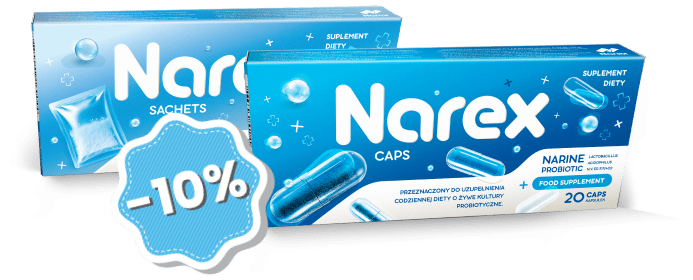
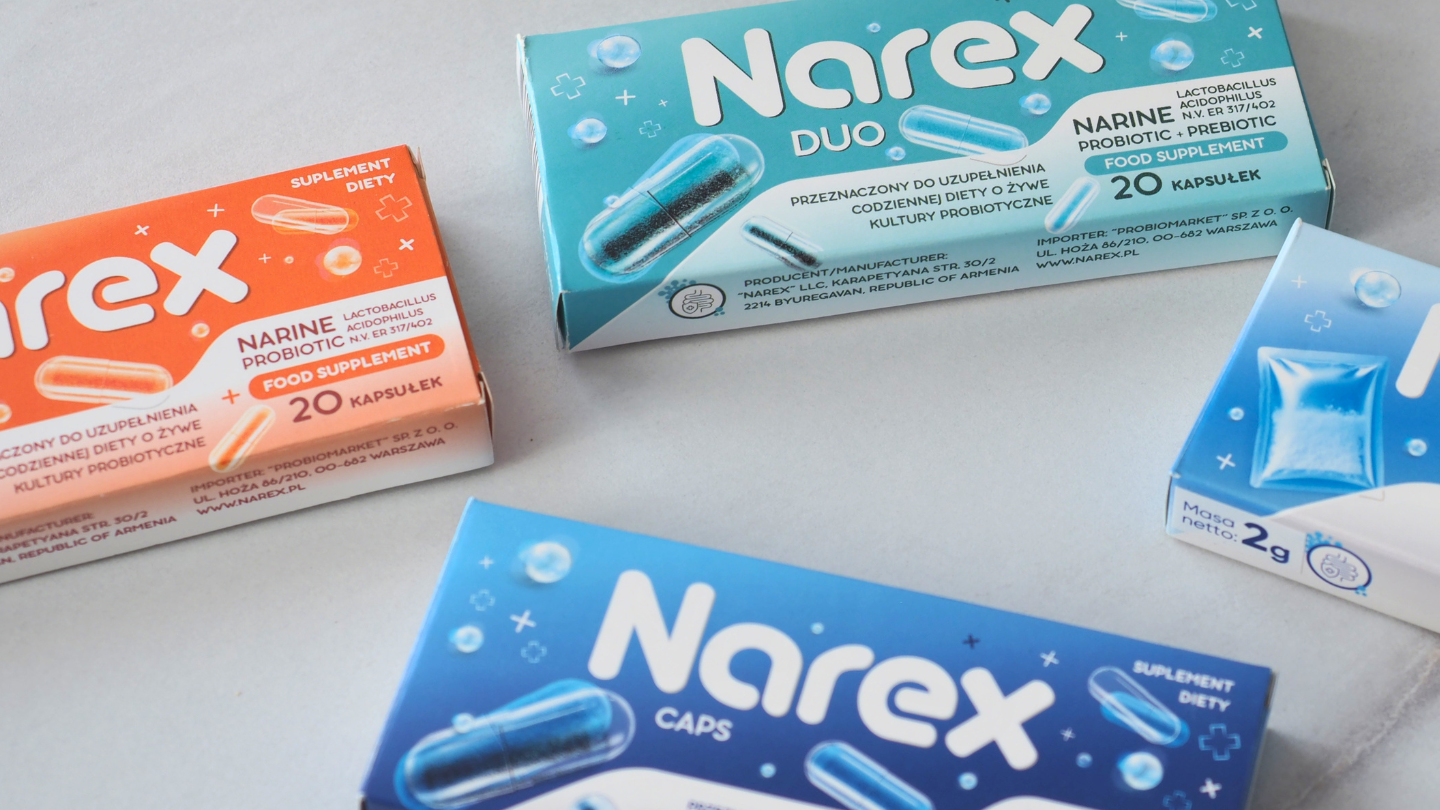
The product range includes four main dietary supplement variants.
Narex Caps – Narine in Capsules
Narex Caps contains the Narine Er 317/402 strain in a traditional capsule format.
A comparable serving contains 1.8 × 10⁸ CFU.
Narex Forte – A Higher Bacterial Count
Narex Forte is a formulation containing an increased number of Narine bacteria.
It provides 2.7 × 10⁸ CFU, which is 50% more than Narex Caps per comparable serving.
Narex Duo – Narine Combined With Inulin
Narex Duo combines the Narine Er 317/402 strain with inulin, a type of soluble dietary fibre.
The product contains 1.8 × 10⁸ CFU of the Narine strain.
Narex Sachets – Narine in Powder Form
Narex Sachets contains a freeze-dried Narine bacterial culture in powder form.
Each sachet provides 3 × 10⁸ CFU.
The powder can be used according to the manufacturer’s instructions and may also serve as a starter culture for preparing Narine fermented milk.
All four products contain the same bacterial strain but differ in their form, bacterial count and additional ingredients.
Explore Narex Narine probiotics.
What Does CFU Mean in Narine Products?
CFU stands for Colony Forming Units.
This measurement indicates the number of viable microorganisms capable of forming colonies under suitable laboratory conditions.
CFU is one of the parameters used to describe products containing live bacterial cultures.
When comparing products, it is useful to consider the CFU count alongside the strain designation and recommended daily serving.
All Narex probiotic variants contain Narine Er 317/402. Their different CFU counts allow consumers to choose a product according to their preferred form and composition.
Why Should Narine Products Be Stored in a Refrigerator?
Narex probiotic products contain live bacteria preserved through freeze-drying, also known as lyophilisation.
Freeze-drying involves removing water from specially prepared material through sublimation. This technique is widely used to preserve microbial cultures.
Although the bacteria are dried, they remain viable microorganisms. Appropriate storage conditions are therefore important for maintaining product quality.
Narex probiotic products should be stored at temperatures up to +8°C.
According to Narex transport guidance, temporary storage outside controlled refrigeration is permitted for up to seven days under the conditions specified by the manufacturer.
After receiving the product, place it in a refrigerator and follow the storage instructions.
Narine and Antibiotic Treatment – The Importance of the Gut Microbiota
Antibiotics are used to treat bacterial infections. Their activity may also affect microorganisms naturally present in the digestive tract.
The effects of antibiotic treatment on the gut microbiota are an important area of scientific research.
Individual strains of lactic acid bacteria differ in their biological characteristics, including their sensitivity to antimicrobial substances.
Documentation concerning Narine also describes its environmental tolerance and antibiotic susceptibility profile.
Anyone considering supplementation while taking medication should follow the recommendations of their doctor or pharmacist.
FAQ – Frequently Asked Questions About the Narine Strain
What Is Narine Er 317/402?
Narine Er 317/402 is a specifically identified lactic acid bacterial strain whose history is associated with Armenia and the research of Professor Levon Erzinkyan. In Narex product documentation, it is traditionally designated as Lactobacillus acidophilus n.v. Er 317/402 Narine.
Is Narine the Same as Lactobacillus acidophilus?
Narine is a specific bacterial strain traditionally classified as Lactobacillus acidophilus. The designation Er 317/402 identifies this particular culture and distinguishes it from other strains.
Who Discovered the Narine Strain?
The discovery and isolation of Narine are associated with research conducted by the team of Armenian microbiologist Professor Levon Akopovich Erzinkyan.
When Was Narine Discovered?
Research leading to the isolation of the strain began in the 1950s. The year 1964 marks an important milestone associated with the formal registration of the bacterial culture.
Where Does the Name Narine Come From?
The strain was named after Professor Levon Erzinkyan’s granddaughter.
Where Is the Original Narine Culture Preserved?
The Narine reference culture is associated with the microbiological collection of the National Academy of Sciences of Armenia. Documentation includes the strain designation Er 317/402 and the deposit identifier MDC 9602.
Does Narex Use the Original Narine Strain?
Yes. According to manufacturer documentation, Narex obtained the right to use the reference Narine culture through an agreement with the National Academy of Sciences of Armenia in 1999.
Do All Narex Probiotic Products Contain the Same Strain?
Yes. Narex Caps, Forte, Duo and Sachets all contain the strain designated Lactobacillus acidophilus n.v. Er 317/402 Narine. The products differ in their CFU counts, forms and compositions.
Can Narine Be Used to Make Yogurt?
Narex Sachets can be used as a starter culture for milk fermentation according to the preparation instructions. The fermented milk product obtained using this strain is historically associated with the name Narine.
Where Can I Buy Original Narine Probiotics?
Original Narex products are available through the official Narex online store and authorised distribution partners.
Conclusion – What Makes the Original Narine Strain Distinctive?
Narine Er 317/402 is a lactic acid bacterial strain with more than 60 years of history associated with Armenian microbiology and fermented dairy production.
Its individual designation, documented origins and preservation as a reference culture are important elements of the strain’s identity.
For Narex products, the manufacturer’s cooperation with the National Academy of Sciences of Armenia, established in 1999, and its use of a bacterial culture connected to the original Narine source are particularly significant.
Today, the Er 317/402 strain is used in Narex products available in capsules and sachets, offering different options for daily supplementation.
Discover Original Narine Probiotics by Narex
This article is intended for educational purposes. Food supplements are not a substitute for a varied diet and healthy lifestyle or for medical treatment prescribed by a healthcare professional.