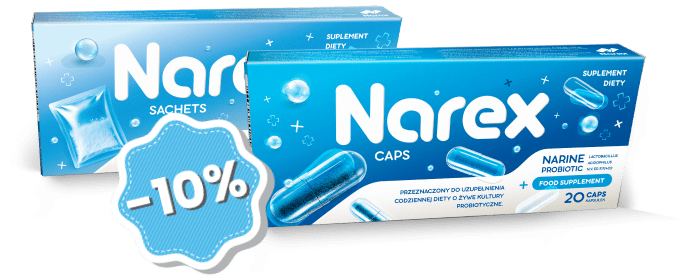

How to Read a Probiotic Label: CFU, Strain, Expiration Date
How to Read a Probiotic Label: CFU, the Narine Strain and Key Information
A probiotic label can tell you much more about a product than just the number of bacteria printed prominently on the packaging. It is worth paying attention primarily to the identification of the strain, the declared number of live microorganisms, the recommended serving and the storage conditions.
Choosing a probiotic consciously should therefore not come down to looking for the product with the highest CFU count. Much more important is which bacteria are present in the product, in what quantity, and whether the manufacturer clearly identifies the strain used.
A good example of precise strain identification is Lactobacillus acidophilus n.v. Er 317/402 Narine, commonly referred to as the Narine strain.
What Does CFU Mean on a Probiotic Label?
CFU stands for Colony Forming Units. It is a unit used to estimate the number of live microorganisms capable of growing and forming colonies.
On supplement labels, CFU values may be expressed in millions or billions per capsule, sachet or recommended daily serving.
However, the CFU count alone does not determine the overall quality of a product.
The type of microorganism used, the specific strain, the way the product is formulated, its stability and the recommended method of use are also important.
For this reason, a product containing a higher number of bacteria is not automatically a better choice than one containing fewer. CFU should always be considered together with information about the specific strain.
Why Is the Specific Bacterial Strain So Important?
When it comes to probiotics, knowing the bacterial species is not always enough. Precise identification at strain level is also important.
For example, Narex products contain the following strain:
Lactobacillus acidophilus n.v. Er 317/402 Narine
The full strain name provides much more precise information about the microorganism than the general term Lactobacillus acidophilus alone.
This is also important when looking for scientific information. Research usually focuses on a specific strain or a precisely defined bacterial culture. Information about one strain should therefore not automatically be applied to all bacteria belonging to the same species.
That is why, when choosing a product, it is worth checking whether the label clearly identifies the specific strain used.
How Can You Check Information About the Narine Strain?
If the full strain name is provided on the packaging, you can look for additional information in scientific publications and specialist databases.
For Narine, useful search terms include the full name:
Lactobacillus acidophilus n.v. Er 317/402 Narine
as well as:
Er 317/402 Narine.
One of the databases commonly used to search for scientific publications is PubMed.
At the same time, an important distinction should be made: research on a specific bacterial strain is not automatically research on a specific dietary supplement sold on the market. When interpreting scientific publications, it is always necessary to check what exactly was tested.
Does a Higher CFU Count Mean a Better Probiotic?
There is no single universal CFU value that defines a good probiotic.
The appropriate number of microorganisms depends, among other things, on the strain used and the characteristics of the specific product. For this reason, comparing products only by looking at the largest number printed on the packaging may lead to incorrect conclusions.
For example, a product containing a clearly identified Narine strain should be considered as a whole: the strain identification, declared CFU count, serving size, product form, storage conditions and the information provided by the manufacturer all matter.
More CFU does not automatically mean better. What matters is which microorganisms are present in the product and in what amount.
Why Does the Expiry Date Matter?
Probiotics contain live microorganisms, so their number may change over time.
From the consumer’s perspective, it is therefore important not only how many bacteria were present immediately after production, but also what storage conditions are recommended and for how long the product retains its declared parameters.
When buying a probiotic, it is worth checking:
the best-before or expiry date, the declared bacterial count and the recommended storage conditions.
This makes it easier to store and use the product in accordance with the manufacturer’s instructions.
How Do Storage Conditions Affect a Probiotic?
Temperature, humidity and light may affect the stability of products containing live bacteria.
However, this does not mean that all probiotics should be stored in the same way. Individual products may have different requirements depending on the production technology, bacterial strain, product form and packaging.
The most important rule is therefore simple:
always follow the storage instructions provided on the packaging of the specific product.
If the manufacturer recommends a particular temperature range, those instructions should be followed. Products should also be protected from excessive heat, moisture and direct sunlight in accordance with the information on the label.
Does Every Probiotic Need to Be Refrigerated?
No.
Some probiotics require refrigeration, while others are designed to remain stable under different storage conditions.
It is therefore incorrect to assume that every probiotic must be stored at 2–8°C.
The most reliable source of information is always the product label and the manufacturer’s storage instructions.
If you are unsure how to store a particular Narine product, check the information provided directly on its packaging.
What Legal Information Can Be Found on Supplement Labels?
In Poland and the European Union, dietary supplements are subject to food law and regulations concerning labelling and advertising.
Rules concerning nutrition and health claims are particularly important. Manufacturers cannot freely attribute disease-prevention, treatment or curative properties to dietary supplements.
For this reason, when assessing a product, it is useful to distinguish between three separate categories:
information about the product’s composition, scientific information concerning a particular bacterial strain, and claims relating to the effects of the dietary supplement itself.
These are not the same thing.
This distinction also applies to the Narine strain. Information about its history, characteristics or scientific publications should be clearly separated from claims concerning the effects of a specific commercial supplement.
What Should You Look for When Choosing a Probiotic?
Instead of focusing only on advertising claims or the highest CFU number, it is worth checking several basic pieces of information.
First, see whether the manufacturer clearly identifies the strain used. In Narex products, this is Lactobacillus acidophilus n.v. Er 317/402 Narine.
Then check the CFU count and what quantity of the product it refers to. It may be stated per capsule, sachet or recommended daily serving.
It is also worth reviewing the instructions for use, storage conditions and expiry date.
If you are interested in scientific documentation, search for information concerning the exact strain used in the product, not only the bacterial species.
How to Read a Probiotic Label Step by Step
First, find the name of the microorganism and check whether a specific strain is identified.
Next, check the declared CFU count and determine whether it refers to one capsule, one sachet or the full daily serving.
Then review the recommended method of use and storage conditions.
Finally, check the manufacturer’s details, the ingredient list and the expiry date.
Only by considering all of these elements together can you get a more complete picture of the product.
Frequently Asked Questions
Is 50 Billion CFU Better Than 1 Billion CFU?
Not necessarily. The CFU count alone is not enough to compare two products.
The specific strain, product form, recommended serving and overall formulation should also be taken into account.
A higher bacterial count does not automatically mean a better product.
Are All Probiotic Strains the Same?
No. Individual strains may differ in their biological characteristics, which is why precise strain identification is important in scientific publications.
For this reason, the general term Lactobacillus acidophilus is less precise than the full strain name Lactobacillus acidophilus n.v. Er 317/402 Narine.
What Is the Narine Strain?
Narine is a name associated with the strain Lactobacillus acidophilus n.v. Er 317/402 Narine, whose history is connected with Armenia.
Its history, origin and characteristics are associated with the development and study of this particular bacterial strain.
Does a Probiotic Have to Be Stored in the Refrigerator?
Not every probiotic requires refrigeration.
Storage requirements depend on the specific product and the technology used in its preparation.
Always follow the manufacturer’s instructions provided on the packaging.
How Can I Find Research on the Narine Strain?
Scientific publications can be searched using the full strain name, for example Lactobacillus acidophilus n.v. Er 317/402 Narine, or the designation Er 317/402 Narine.
When reviewing a publication, check whether the study concerns the exact strain and what exactly was investigated.
Does the Place of Purchase Determine Probiotic Quality?
No. The fact that a product is sold in a pharmacy, a physical store or an online shop is not enough to assess its quality.
It is more useful to check the composition, strain identification, CFU count, storage conditions, manufacturer information and other details provided on the label.
Summary
A well-prepared probiotic label should allow the consumer to understand which microorganisms are present in the product, in what quantity, and how the product should be stored and used.
For this reason, choosing a probiotic should not be based solely on the highest CFU number.
Precise identification of the bacterial strain is particularly important.
In Narex products, this strain is Lactobacillus acidophilus n.v. Er 317/402 Narine.
Sources
European Food Safety Authority (EFSA)
EUR-Lex — European Union law
European Commission — EU Register of Nutrition and Health Claims