What ‘Narine Er 317/402’ Means – Strain ID Explained
Narine Er 317/402 is the specific identification of a lactic acid bacterial strain originating from Armenia. The designation Er 317/402 distinguishes this microorganism from other bacterial strains and connects it to decades of microbiological research, scientific publications, and the original Narine culture.
The strain is traditionally identified as Lactobacillus acidophilus n.v. Er 317/402 Narine. It was studied by Armenian microbiologist Professor Levon Akopovich Erzinkyan and his research team and subsequently became the basis for fermented dairy products and preparations containing live bacterial cultures.
Understanding this identification helps explain why the precise strain designation matters, how Narine is identified in scientific literature, and what connects modern Narex products to the original Armenian culture.
What Does the Name Narine Er 317/402 Mean?
The designation combines several elements that identify a particular bacterial culture.
Lactobacillus refers to the bacterial genus under which the microorganism has traditionally been classified.
acidophilus is the species name used in the historical identification of Narine.
n.v. is part of the traditional designation appearing in the strain’s documentation.
Er 317/402 is the strain identifier associated with the original Armenian culture.
Narine is the historical name given to the strain by its researcher.
Together, these elements form the commonly used designation:
Lactobacillus acidophilus n.v. Er 317/402 Narine
The most important distinction is that Er 317/402 identifies the bacterial strain rather than the commercial product, its bacterial concentration, or a manufacturing batch.
The designation appears in scientific literature dating back several decades, demonstrating its role as a microbiological identifier.
Where Does the Er 317/402 Strain Identifier Come From?
The history of Narine is closely associated with Professor Levon Akopovich Erzinkyan, an Armenian microbiologist whose research focused on lactic acid bacteria.
The strain was isolated and studied in Armenia during the 20th century. Research concerning Narine was formally registered in 1964.
The name Narine was given in honour of Professor Erzinkyan’s granddaughter.
The numerical designation 317/402 became associated with the particular culture identified and investigated by Armenian researchers.
The letters and numbers are therefore part of the historical identification of the strain.
They should not be interpreted as a CFU count, production date, product version, or batch number.
Is Er 317/402 a Laboratory Batch Number?
No. Er 317/402 is used as a strain designation in microbiological documentation and scientific publications.
A production batch number identifies a particular quantity of a product manufactured under specified conditions. Different batches of the same supplement may have different batch numbers while containing the same bacterial strain.
In contrast, the strain designation remains associated with the microorganism used in production.
For Narex products, Er 317/402 identifies the Narine bacterial strain, regardless of whether it is supplied in capsules or sachets.
Why Is Identification at the Strain Level Important?
Bacteria are classified at several taxonomic levels, including genus, species, and strain.
Microorganisms belonging to the same species may share many characteristics while differing in their genetic composition, metabolic activity, and interactions with their environment.
For this reason, microbiological research increasingly focuses on precisely identified bacterial strains.
Species Identification vs Strain Identification
A species name identifies a broader group of related microorganisms.
A strain designation identifies a specific microbial lineage within that group.
For example, two products may both contain bacteria identified as Lactobacillus acidophilus, but the microorganisms used may belong to different strains.
Such strains can differ in their fermentation characteristics, production of metabolites, and behaviour under particular environmental conditions.
The designation Er 317/402 is what distinguishes Narine from other strains historically classified as Lactobacillus acidophilus.
This distinction is important when interpreting scientific studies, comparing microbial cultures, and identifying ingredients used in supplements.
How Is Narine Er 317/402 Identified in Scientific Publications?
Scientific literature uses several related designations for the Narine strain.
These include:
- Lactobacillus acidophilus n.v. Er 317/402 Narine
- Lactobacillus acidophilus INMIA 9602 Er 317/402
- Lactobacillus acidophilus INMIA 9602 Er-2 strain 317/402
The appearance of these identifiers in scientific publications allows researchers to associate studies with the historically documented Narine culture.
The INMIA 9602 Designation
INMIA 9602 is an additional identification appearing in research involving Narine.
It is particularly visible in scientific articles published by Armenian and international research teams.
For example, a 2017 study published in Letters in Applied Microbiology used the designation:
Lactobacillus acidophilus INMIA 9602 Er-2 strain 317/402
The article investigated selected growth characteristics of intestinal Escherichia coli bacteria following administration of a Narine-containing preparation.
In 2018, a study published in Frontiers in Immunology used the designation Lactobacillus acidophilus INMIA 9602 Er 317/402.
In 2021, another scientific publication included the complete identification Lactobacillus acidophilus Strain INMIA 9602 Er 317/402 Narine.
These publications demonstrate that the strain identifier is established in scientific literature and is not simply a marketing designation.
Is Narine Er 317/402 Deposited in a Microbial Culture Collection?
Microbial culture collections preserve identified microorganisms and support their availability for scientific and technological applications.
According to the historical documentation published by Narex, the original Narine culture is deposited at the Republican Microbe Deposit Center of the National Academy of Sciences of Armenia.
The reference culture forms part of the documentation associated with the strain’s origin.
In 1999, the Armenian manufacturer Narex entered into an agreement with the National Academy of Sciences of Armenia concerning the use of the reference Narine culture.
This relationship is an important part of the traceability and historical identity of the microorganism used in Narex products.
Is a DSMZ or ATCC Number Required to Identify Narine?
Microorganisms may be maintained and identified through different recognised culture collections, each using its own accession system.
Examples include the German Collection of Microorganisms and Cell Cultures (DSMZ) and the American Type Culture Collection (ATCC).
However, a strain does not have to possess a DSMZ or ATCC accession number for its historical identity to be documented.
Narine is associated with Armenian microbiological institutions and is identified in scientific publications using designations including Er 317/402 and INMIA 9602.
A public culture collection accession, strain identifier, and production batch number serve different purposes and should not be confused.
Has the Classification of Narine Er 317/402 Changed?
Microbial taxonomy develops as new analytical methods become available.
Historically, Narine Er 317/402 has been described as Lactobacillus acidophilus.
However, a scientific publication from 2020 in the Biological Journal of Armenia reported a taxonomic reassessment of the original Narine fermented milk starter culture.
Based on morphological, physiological, biochemical, and molecular genetic analyses, the authors identified the culture as Lactobacillus helveticus Er 317/402.
This illustrates why the strain identifier is particularly important when examining historical and modern scientific documentation.
Taxonomic classifications may be reassessed, while the historical designation helps researchers identify the culture being discussed.
For consistency with its established documentation, Narex products continue to use the traditional designation:
Lactobacillus acidophilus n.v. Er 317/402 Narine.
How Does the Er 317/402 Identifier Connect Scientific Research to Narine?
A precisely identified strain makes it possible to locate publications concerning a particular microorganism rather than relying solely on research involving a broader bacterial species.
The Narine Er 317/402 designation appears in studies investigating different microbiological characteristics.
Research on Antimicrobial Activity
A study published in 2010 examined an antimicrobial peptide produced by the strain identified as Lactobacillus acidophilus n.v. Er 317/402 Narine.
The researchers isolated and characterised a peptide called acidocin LCHV.
The study contributed to the understanding of antimicrobial compounds produced by the bacterial culture under laboratory conditions.
Research on Gut Microorganisms
A 2017 study investigated changes in selected growth parameters of commensal Escherichia coli isolated from individuals with familial Mediterranean fever after administration of a Narine-containing preparation.
Further research published in 2018 examined changes in selected intestinal microbial populations associated with administration of the strain.
In 2021, researchers investigated the relationship between Narine administration and Prevotella bacteria in the gut microbiota.
These studies demonstrate the importance of consistent strain identification in microbiological research.
The findings relate to the specific experimental conditions and populations studied and should not automatically be interpreted as proof of therapeutic effects for every commercial product containing Narine.
How Is the Original Narine Er 317/402 Strain Used in Narex Products?
Narex is an Armenian manufacturer that has been developing products containing the Narine strain since 1999.
The company’s products use the strain traditionally identified as Lactobacillus acidophilus n.v. Er 317/402 Narine.
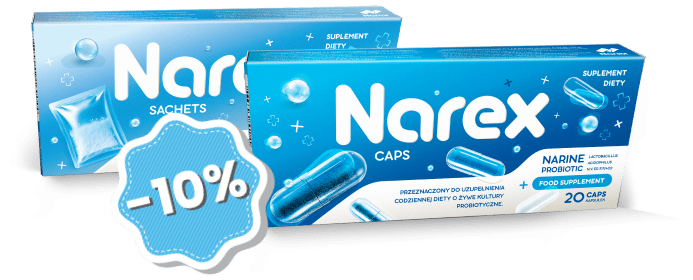
The Narex range includes capsules and sachets containing freeze-dried bacterial cultures.
The available variants differ in bacterial concentration, formulation, and additional ingredients, but share the same strain identification.
| Product | Narine strain | Declared bacterial count |
|---|---|---|
| Narex Caps | Er 317/402 | 1.8 × 10⁸ CFU |
| Narex Forte | Er 317/402 | 2.7 × 10⁸ CFU |
| Narex Duo | Er 317/402 | 1.8 × 10⁸ CFU |
| Narex Sachets | Er 317/402 | 3 × 10⁸ CFU |
Narex Duo additionally contains inulin.
The CFU count describes the declared number of viable microorganisms, while Er 317/402 identifies the bacterial strain.
These are two separate pieces of product information.
Explore Narex products containing the Narine Er 317/402 strain.
How Can You Identify the Original Narine Strain?
When reviewing a Narine product or scientific publication, several details can help establish the identity of the microorganism.
Check the Complete Strain Designation
Look for Lactobacillus acidophilus n.v. Er 317/402 Narine or a corresponding scientific designation referring to Er 317/402.
Distinguish the Strain Number from CFU
The Er 317/402 designation identifies the bacterial strain.
CFU describes the declared quantity of viable microorganisms in a particular serving.
A higher CFU count does not represent a different strain.
Examine the Historical Origin
The original Narine culture is associated with Professor Levon Erzinkyan, Armenian microbiological research, and the National Academy of Sciences of Armenia.
Compare Scientific Identifiers
Scientific publications may use additional identifiers such as INMIA 9602.
When researching the strain, these designations can help locate relevant scientific literature.
FAQ – Frequently Asked Questions About the Narine Er 317/402 Strain ID
What Does Narine Er 317/402 Mean?
Narine is the historical name of a specific Armenian lactic acid bacterial strain. Er 317/402 is its strain identifier, distinguishing it from other bacterial cultures.
Is Er 317/402 a Batch Number?
No. Er 317/402 is a bacterial strain designation. Manufacturing batch numbers identify individual production batches and may change from one batch to another.
Does 317/402 Represent the Number of Bacteria?
No. The numbers 317/402 are part of the strain identifier. The quantity of viable bacteria in a supplement is expressed separately in CFU.
What Is the Full Scientific Name of Narine?
The traditional designation is Lactobacillus acidophilus n.v. Er 317/402 Narine. Scientific literature also uses identifiers such as INMIA 9602 Er 317/402.
What Is INMIA 9602?
INMIA 9602 is an additional identifier appearing in scientific publications concerning the Narine strain. It is used alongside the Er 317/402 designation.
Is Narine Er 317/402 the Same as Every Lactobacillus acidophilus Strain?
No. Narine Er 317/402 identifies a particular bacterial strain. Other bacteria historically classified as Lactobacillus acidophilus may have different strain designations and biological characteristics.
Was Narine Er 317/402 Scientifically Identified?
Yes. The strain has been documented in Armenian microbiological research and appears under specific identifiers in scientific publications, including studies published in 2017, 2018, and 2021.
Has Narine Been Identified as Lactobacillus helveticus?
A 2020 Armenian scientific publication reported the re-identification of the original Narine fermented milk starter culture as Lactobacillus helveticus Er 317/402. The historical designation Lactobacillus acidophilus Er 317/402 remains widely used in the strain’s documentation.
Where Is the Original Narine Culture Preserved?
According to Narex’s historical documentation, the original strain is deposited at the Republican Microbe Deposit Center of the National Academy of Sciences of Armenia.
Where Can I Find Products Containing Narine Er 317/402?
Narex products containing the original Narine strain are available through the official Narex online store and its distribution partners.
Conclusion – Why the Narine Er 317/402 Strain ID Matters
Er 317/402 is the identifying designation of the original Narine bacterial strain developed and studied in Armenia.
It distinguishes the microorganism from other lactic acid bacterial strains and connects it to decades of microbiological documentation and scientific research.
The strain is traditionally known as Lactobacillus acidophilus n.v. Er 317/402 Narine, while scientific publications also use identifiers such as INMIA 9602.
Its historical origin is associated with Professor Levon Erzinkyan and Armenian microbiological institutions, including the National Academy of Sciences of Armenia.
Understanding the difference between a strain identifier, species name, culture collection reference, and CFU count makes it easier to interpret scientific studies and product information.
Narex products use the original Narine Er 317/402 strain, maintaining a connection with the documented Armenian bacterial culture.
Discover Narine Er 317/402 in Narex Probiotics
Scientific References
- Pepoyan A.Z. et al. (2017). Lactobacillus acidophilus INMIA 9602 Er-2 strain 317/402 probiotic regulates growth of commensal Escherichia coli in gut microbiota of familial Mediterranean fever disease subjects. Letters in Applied Microbiology, 64(4), 254–260. DOI: 10.1111/lam.12722.
- Pepoyan A.Z. et al. (2018). Probiotic Lactobacillus acidophilus Strain INMIA 9602 Er 317/402 Administration Reduces the Numbers of Candida albicans and Abundance of Enterobacteria in the Gut Microbiota of Familial Mediterranean Fever Patients. Frontiers in Immunology, 9, 1426. DOI: 10.3389/fimmu.2018.01426.
- Pepoyan A.Z. et al. (2021). The Effect of Immunobiotic/Psychobiotic Lactobacillus acidophilus Strain INMIA 9602 Er 317/402 Narine on Gut Prevotella in Familial Mediterranean Fever: Gender-Associated Effects. Probiotics and Antimicrobial Proteins, 13, 1306–1315. DOI: 10.1007/s12602-021-09779-3.
- Hovhannisyan G.G. et al. (2020). Species Identification of the Starter Culture of the Therapeutic-Dietary Fermented Milk Beverage “Narine”. Biological Journal of Armenia, 72(1–2). Scientific publication.
- Purification, characterisation and identification of acidocin LCHV, an antimicrobial peptide produced by Lactobacillus acidophilus n.v. Er 317/402 strain Narine. International Journal of Antimicrobial Agents, 2010.
- Narex – History of Narine.